If you run a business in South Africa, your customers expect quick answers – on your website and on WhatsApp. A website chatbot South Africa businesses can actually use should reply in seconds, speak your customers’ languages, price in Rand and pass serious buyers straight to your phone. This guide explains what to look for and how to get one running on your site this week.
Why South African businesses are adding a website chatbot
Most small businesses here have the same problem: enquiries arrive at all hours, and the team is busy serving the customers already in front of them. A question sent at 9 pm on a Sunday often waits until Monday – and by then the visitor may have booked somewhere else.
A website chatbot closes that gap. It answers questions about your services, prices, hours and location the moment they are asked, collects the visitor’s details and lets you follow up when you are ready. You stay in control of the conversations that need a human touch.
Choosing a website chatbot in South Africa: what it should do
Not every chatbot is built for how South Africans buy. Before you choose one, check that it can:
- Answer 24/7 from your own information – services, prices, policies and FAQs – without inventing answers.
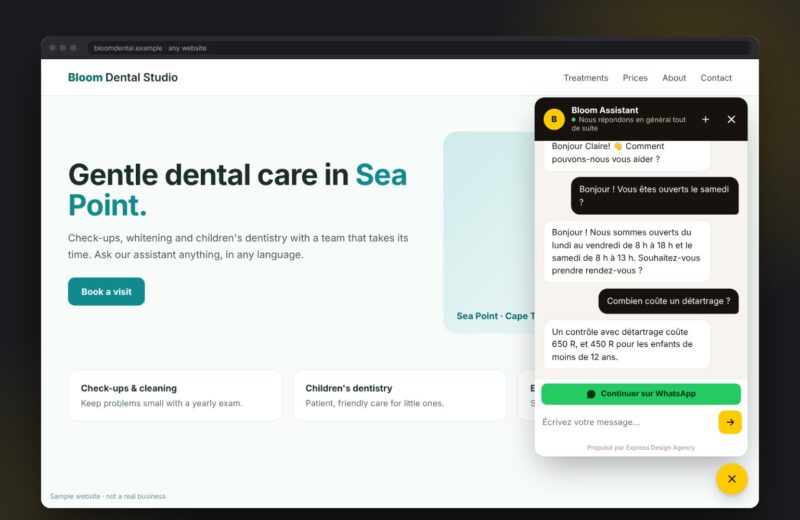
- Reply in your customers’ language. ED-ChatBot answers in English, Zulu, French, Portuguese, Swahili and more, so a visitor who writes in isiZulu gets a reply in isiZulu.
- Hand hot leads to WhatsApp, where many of your customers already prefer to talk.
- Take bookings and send reminders, so appointments don’t get forgotten.
- Request reviews and share payment links once the job is done.
- Keep every conversation in one team Inbox, so nothing gets lost between staff members.
Speak to every customer in their language
South Africa has 12 official languages, and many of your customers switch between them every day. A chatbot that only speaks English leaves part of your market waiting for a reply they would understand better.
With a multilingual chatbot, the visitor simply writes in the language they’re comfortable with and the bot answers in kind. You don’t need to write your FAQs in every language – you give the bot your information once. Read more in Why your website should answer in your customer’s language.
From your website to WhatsApp in one tap
A website chat is often the first contact, but WhatsApp is where the sale happens. When a visitor is ready to book or buy, ED-ChatBot passes the lead to your WhatsApp with the details already collected, so you can pick up the conversation without asking the same questions again.
On the Pro plan, you also get a WhatsApp bot that answers common questions on your WhatsApp number itself. We explain the full flow in From website chat to WhatsApp: stop losing hot leads.
Website chatbot pricing in Rand
Many chatbot tools are priced only in dollars or euros. ED-ChatBot is made by a Cape Town agency and priced for local small businesses:
- Free – 50 chats a month to try it on your site.
- Starter – R169 a month ($10) – 500 AI chats a month.
- Pro – R299 a month ($18) – 2,000 AI chats a month and the WhatsApp bot.
- Customised – on request, for bigger teams or special workflows.
Every paid plan comes with a 7-day free trial. You can see the bot working on your own website before you pay a cent.
Which South African businesses benefit most?
Any business that answers the same questions over and over can save time with a chatbot. It works especially well for:
- Salons and spas – bookings, price lists and reminders.
- Dentists and clinics – appointment requests and practical questions. See our post on chatbots for dentists.
- Guesthouses and travel businesses – availability questions from visitors in many languages.
- Trades and home services – capturing job details and contact numbers for a quote.
- Online shops – delivery, returns and payment questions.
Three mistakes to avoid
A chatbot is only as good as the way it is set up. These are the mistakes we see most often:
- Letting it guess. If the bot doesn’t know an answer, it should say so and offer to connect the visitor with your team – not invent a price or a promise.
- Hiding the human. Always give visitors a clear way to reach a person, especially for complaints or complicated quotes.
- Setting it and forgetting it. Your prices, hours and specials change. Update the bot when they do, and check its conversations regularly so the answers stay accurate.
Our post What a website chatbot should and shouldn’t say goes deeper into the rules we set for every client.
How to add a chatbot to your website
Getting started takes three steps and no developer:
- Add your business information – services, prices, hours, FAQs and policies.
- Set the rules – which details to collect, when to hand over to WhatsApp and which topics to leave to your team.
- Put it on your site – paste the snippet or install the WordPress plugin, and the chat window goes live.
Spend a few minutes each day of the first week reading conversations and fine-tuning answers. Common questions about setup and billing are answered on our FAQ page.
Join the free pilot programme
We are offering a free pilot programme to five businesses until 31 January 2027. Pilot businesses get ED-ChatBot set up with hands-on help from our Cape Town team, and their feedback shapes the product. [Placeholder: add an approved pilot result or client quote here.]
Try ED-ChatBot free for 7 days
Want a website chatbot that answers your South African customers in their language, day and night? Start your 7-day free trial or ask about a place in the free pilot programme. Learn more on the ED-ChatBot page.